Tuesday, February 10, 2009

LaBarque Creek


There's a new conservation area in town! LaBarque Creek Conservation Area. Over 500 acres of pristine watershed with deep gorges, ferns, mosses, sandstone overhangs, waterfalls and wildlife. It must be one of the most enchanting places in the Spring when the wildflowers and morels start springing forth.

See: mdc.mo.gov

And go check it out for yourself. You might see me lurking around.

Thursday, July 03, 2008

Spring of the Summer Sky

I spent time looking into the abyss of the Spring of the Summer Sky yesterday. She (actually they) spoke to me. I am humbled and terrified. I'll visit her again soon, this time with "the set." I'll send out directions and a rendezvous date for anyone wh0's interested.

We gotta revere the eternal coil before the coil casts us off. Here is The Mother presenting her Pre-Children as counselors, and all we gotta to do is line up and accept them? Could it be that easy?

Some folks just visited The Spring of the Summer Sky with Budweiser, stinky kids and grousing matriarchs. To them it was a big blue hole in the ground. We'll go pre-dawn at fall, with reverence and an amplified sense of wonder. Just let me know if you're in. I'll make a fine breakfast afterwards.

Friday, May 16, 2008

Venison Morel Glaze

Grandma did it by feel and couldn't tell me the recipe. I'll try to do the same here - from memory, an improv recipe I love... adjust the ingredients to suit your taste.

1# venison loin
2 tbsp olive oil
2 cloves garlic, crushed
2 scallions, finely chopped
1 small bay leaf
1 sprig fresh rosemary
1 tsp kosher or sea salt
2 tbsp red raspberry preserves
1 tsp balsamic vinegar - the richer the better
1/4 tsp ground black pepper
1/4# fresh morels, sliced lengthwise
1 bunch white asparagus spears

Cube 1" thick slices of venison loin into flat medallions. Heat olive oil in sautee pan until almost smoking. Add bay leaf, garlic, rosemary and 1/2 of the salt. Sautee until garlic just starts to turn dark. Add venison medallions and sautee for 2 minutes each side - they should be browned outside and lightly rare on the inside. Salt and pepper the medallions, remove and set aside on a serving plate and cover with foil to keep warm.

Cut the asparagus spears in 1" diagonals and steam until lightly done. Remove to serving bowl and add a dollop of butter and a pinch of salt.

Place the scallions, balsamic vinegar and raspberry preserves in the sautee, and heat until the mixture slightly simmers. Add the morels and cook them for several minutes - don't fry them, just cook them.

Serve the venison medallions with the morels and raspberry glaze drizzled on top, alongside a generous helping of asparagus. A nice crusty sourdough bread and a fruity Missouri red wine compliment the meal. When the wife and kids say, "ewww, mushrooms and deer meat!" give them $10 and send them off to McDonalds. Enjoy this feast alone!

Thursday, May 08, 2008

Culinary Ecstasy

Morels again.

Most commonly I egg wash 'em, flour them, and fry them in oil. Tonite I lightly egg washed them, dredged them in plain breadcrumbs, and fried them in pure, unsalted butter, with just a hint of salt and fresh ground black pepper.

Aw my freakin' chakras opened up! Oooooh! I'll never go back to flour and oil.

This weekend I'm gonna repeat the exercise, but this time with leeks, asparagus and medallions of venison loin.

If I die soon after, it will be with a grin the mortician will not be able to remove.

If morels grew year-round, I could easily give up meat.

Tuesday, May 06, 2008

Goodbye Missouri Morels

Farewell until next year, little spongy friends. After a serious ass-busting, bushwhacking last foray, all I could find was one solitary dried-out M. Esculenta. All of the half-frees, all of the gyromitras, all of the blacks, all gone now. With another rainstorm coming in, there's a possibility for more commons by this weekend. But with a freezer full of breaded shrooms and literally a bucket full in the refrigerator, I believe I've given it my all this year.

Last night, I went to the only location likely to produce. I was clouded by black mosquitoes biting me right through ounces of DEET, getting in my eyes and nose and ears. A wise sage once told me that morels put off a scent that drives mosquitoes away, and when the morels have gone the mosquitoes attack. Maybe so, maybe no. But it is a ripping yarn nonetheless.

If you are pure in heart and respect Mother Gaia's sacred places, the morel will find you, too.

Saturday, May 03, 2008

More and More Morels

More and more morels.  37 thursday eve.  Morel huting has consumed my life so I had to lay off a few days to meet my pink-assed employer's demands and my whinin' assed family's insecurities.  If only they knew how easily they could be summarily dismissed in favor of a lowly fungus.  Come to think of it, this magical morel season has caused me to re-think quite a few things.  But I digress...

Anyway, tonight, I egg-wash, flour and flash-freeze five pounds of my best M. Esculentas.  There'll be a fried morel feast at the C3 summer solstice show.  I just egg-wash 'em with 50% egg, 50% water with a generous portion of salt and coarse ground black pepper.  I put 'em on a cookie sheet with waxed paper, egg 'em, flour 'em, put 'em on the sheet, and toss 'em into the deep freeze.  Once frozen they go into a gas-tight bag (I use baking bags and suck the air out of them) and back into the deep freeze.

Wednesday, April 30, 2008

Morelizing Again!

Another 33 fine M. Esculentas last night in the vicinity of the Missouri River bottoms. Easily a quarter of them were new growth!

Monday, April 28, 2008

Mushroom Maelstrom

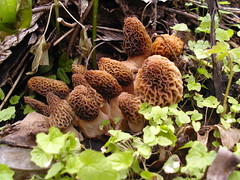
...just a quick hike in the vicinity of Twin Rivers tonight -- just spent an hour in the woods. Yield: 77 common morels, nice ones. Here's tonite's haul!


Here are a couple of shots of the larger blondes and the grays:


Morel Dilemma


What to do with all those mushrooms? A Puzzlement!

I scoured the Crescent Hills Saturday again. Found a young hobo lost, looking for water and directions - had just come off of a freight from Portland headed for Georgia. He couldn't understand why no one would befriend him. I gave him water and directed him to the kind ladies at Route 66 Park.

Moments later I popped out of the woods on top of a popular mountain bike trail. There at my feet were a couple dozen 3" beautiful black morels. The trail riders were oblivious. I packed them up and headed home for some spring yard work.

As I stacked brush I noticed several verpa bohemica (30 or so) and as I picked them I also noticed two 10" blacks, standing right there next to my rock garden. We use no pesticide or artificial fertilizers so those 'shrooms went right into the basket!

Yesterday I decided to brave the drizzle and spend another afternoon in the woods. Jackpot! Underneath blooming may apples, I found about 20 yellows, common morels, in perfect shape, all 5" to 8". I filled my bag and headed home to clean them.

I feasted on blacks and yellows last night. I'll have morels aplenty for the next week. But it doesn't stop there: The weather has turned cool and rainy again, so the fruiting will continue perhaps for weeks.

This has been the best year for Morels that I can remember.

Monday, April 21, 2008

Morel Imperative

First morels of the season! Jackpot!

Aside from the 50 or so ticks I picked off of me (no pain, no gain) I had good luck on this first fruiting of 2008. On April 19 I spent 4 hours in the woods. Here's the yield:

- over 20 Verpa Bohemicas - small and delicate.
- 16 Morchella angusiceps - nice, 3" classic black morels
- One solitary Morchella esculenta - small but lovely and meaty

Sunday morning I had these mushrooms with homemade Missouri small-farm raised pork sausage with lots of sage in natural casings. A breakfast fit for a king.

Where did I find the morels? In the woods, of course!

Tuesday, April 08, 2008

Morel Scout 2008 First Run

Yesterday I took a long foray into the Crescent Hills area scouting morels. Not a thing. Trilliums are up and showing but no blooms, oak leaves are not even out yet. Moderately warm, slow rainfall today may bring them out tomorrow.

But at least I did get my first tick of the season!

Friday, March 28, 2008

Morels are Coming!


Missouri morels are on the way!  This should be the best season in the last decade since we've had ample snow and moisture.  Old-timers say April 15 but with climate change I'll be in the woods as early as next week.

The morel will let you find it if you are pure in heart and respect its fleshy-folded goodness!  Curse it and it will hide.

Saturday, February 23, 2008

Slingshot Effect

Sometimes I wonder how I manage to keep rolling.

Last Friday I headed for a calming weekend on the Ozark Trail, near the devastation of Johnson Shut-ins... Bell Mountain Wilderness to be precise. Leaving St. Louis at a balmy 50 degrees, I found myself on the trail in the wilderness area crunching away on 5 inches of snow topped with an inch of ice. A fatiguing trek for sure. The temperature was in the upper 20's. After building a nice base camp, collecting downed wood, building star fires and settling in things looked pretty mellow if not a radical change from St. Louis.

Saturday evening the skies opened and a torrential downpour ensued until dawn. The ice and snow was rendered snowmelt, and Sunday morning it was time to go home to catch a plane for Manhattan. Except for one small detail: the tiny streams I had crossed Friday were now waist-deep torrents of frigid water. My exit was delayed as I erred on the side of caution. Crossing the last stream with the aid of rope-up, I headed home for the airport, wet and delirious.

From the wilderness to the chaos of 7th Avenue in less than 24 hours slung me into a physical/spiritual/mental change of existence pretty damned fast! I had just enough time to get used to the balmy NYC weather when I boarded a train to Philly and was stranded in amajor snowstorm. I'm packed up and heading home to High Ridge. I'll get home, groove on the family, spend some time in the Audubon Greenway (my back yard!) and then back to NYC.

I'm getting too old for this shit (not!). Resilience is everything! And they say acid takes a lot out of you. Compared to my week of environmental ups and downs, a healthy dose right now would seem like nothing more than a shot of whiskey on a cold morning.

Sunday, July 09, 2006

PET Projects

A universal rule in backpacking is, "always try to get two or more uses out of a single item." The value is obvious, more so when you're calculating weight down to the gram. A good, additional rule might be, "...and use something again after it is discarded." This plays right in to an all-around low impact presence both in town and in the wilderness. I've been talking about ho-made camping gear more than a bit... not just because it is cheap, but it is an adaptation behavior we might need some day when, as the hippies used to say, "the shit comes down." Here are some thoughts regarding the king of recyclable plastic, Polyethylene Terephthalate (PET).

PET is one of the oldest of the recyclable plastics, dating back to the 1940's. Unlike most plastics, it lends itself to recycling. According to the EPA, recycling a pound of PET saves approximately 12,000 BTU’s of energy consumption. And since PET is totally recyclable and the basis for many synthetic fibers, here's what it can yield:
  • Fourteen 20 oz. PET bottles yield enough fiber for an extra large T-shirt.
  • Fourteen 20 oz. PET bottles make one square foot of carpet.
  • Sixty-three 20 oz. PET bottles make a sweater.
  • Fourteen 20 oz. PET bottles yield enough fiberfill for a ski jacket.
  • Eighty-five 20 oz. PET bottles make enough fiberfill for one sleeping bag.

PET is also extremely lightweight in relation to its strength. Consider the ubiquitous 1 and 2 liter soft drink bottles. Strong, featherweight, the ideal container to fill with liquids and toss into the backpack. And it can die and be resurrected several times during the trek, and even then the remains can be returned to civilization where they go right back into the system. So, here are four uses for a two-liter bottle:

  1. Bring your bottle into the wilderness full of water or your favorite beverage. Consume!
  2. Cut the bottle three inches from the bottom, and use the bottom for a cereal or mixing bowl.
  3. Cut the bottle four inches from the top. Remove the cap and nest a coffee filter into the funnel-shaped top. Use this to pre-filter ground water before treatment.
  4. Use the remaining six inch ring of plastic as a ground lantern. Put a candle on the ground and set the ring around it to keep the wind out.


Some other musings on the trail use of PET:
  • A plastic bottle also makes a good latrine for cold weather camping. (You don't have to 'go' very far from your sleeping bag). Keep it just out side the tent flap.
  • Use a bottle as a large float for fishing. Tie a nylon line on the rim of the jug, long enough to throw the jug out at least ten feet. Tie the other end to a limb on the bank. Put a stage of fishing line, a hook and sinker onto the rim of the jug and bait it. Toss the baited jug out like a giant bobber.


So, what's your PET project?

Tuesday, June 20, 2006

Thinking Inside of the Box

Cardboard Box Oven


A cardboard box will make an oven -- and it works just as well as your oven at home! There are different ways to make a cardboard box oven. The two described here are the most common, but you can dream up your own design. Good boxes for ovens include:

  • Brewery long neck beer returnable box (the best – heavy duty with a lid)
  • Whiskey or wine case boxes
  • Copy paper boxes

The principle is simple: Line a cardboard box inside and outside completely with heavy duty aluminum foil. Provide some means of keeping the food away from the coals. Use charcoal briquettes to control the temperature. A properly made cardboard box oven will last for many uses, costs practically nothing, and recycles a cardboard box. Not only that, it will bake things outdoors you thought could only be made indoors!

Style #1: The Open Top Box Oven

Cut off the flaps so that the box has four straight sides and bottom. The bottom of the box will be the top of the oven. Cover the box inside completely with foil, placing the shiny side out (hint: use Elmer’s glue to stick the foil to the box)

To use the oven, place the pan with food to be baked on a footed grill over the lit charcoal briquets. The grill should be raised about ten inches above the charcoal. In the picture below, soft drink cans raise the baking pan above the coals. Set the cardboard oven over the food and charcoal. Prop up one end of the oven with a pebble to provide the air charcoal needs to burn - or cut air vents along the lower edge of the oven.


Figure 1 - Simple open-top oven

Style #2: The Copy Paper Box Oven

The cardboard boxes that hold reams of paper, 10 reams of 8 1/2 by 11 inch paper, or 10 reams of 8 1/2 by 14 inch paper, will make very nice box ovens. Line the inside of the box and lid with aluminum foil. Use a sponge to dab some Elmer's glue around the inside and cover to hold the foil in place. Make a couple holes in the cover to let the combustion gases out, and make a few holes around the sides near the bottom, to let oxygen in.

Make a tray to hold the charcoal using one or two metal pie plates. You can either make feet for a single pie plate using nuts and bolts, or bolt two pie plates together bottom to bottom. Cut a couple coat hangers to make a rack to hold up the cooking pan. Poke the straight pieces of coat hanger through once side, and into the other.


Figure 2 - Box showing coat hanger wire rack

Put several lit briquettes on the pie pan, put your cooking pan on the rack, and place the cover on top. The first time you use this box oven, check it a few times to make sure that enough oxygen is getting in, and enough gases are escaping, to keep the charcoal burning. A nice enhancement would be adjustable vents on the bottom and lid to control the burn. Brass brads and disposable aluminum pie plate are some possible draft door materials.

Box Oven Tips

  • Control the baking temperature of the oven by the number of charcoal briquettes used. Each briquette supplies 40 degrees of heat (a 360 degree temperature will take 9 briquettes).
  • Experiment! Build an oven to fit your pans - or your menu: Bake bread, brownies, roast chicken, pizza or a coffee cake.
  • Construct a removable oven top or oven door. Punch holes on opposite sides of the oven and run coat hanger wire through to make a grill to hold baking pans.
    Try the oven over the coals of a campfire.
Field Trials

The C3 Psychoto-electro Arkestra encampment at the Peace Conspiracy Festival in June 2006 featured demonstrations of this apparatus. The copy paper box model was built and used. A slight field modification had to be made to allow enough air for comubstion. A slit door 1" by 2" was cut in the side of the box a couple of inches from the bottom. This allowed the oven to burn perfectly with the lid snugly on.

Few festival-goers had heard of such a thing (although they are all veteran hippie campers!) and quite a bit of interest was generated. Of course, having some good things to eat did not hurt at all. Here's what was prepared:
  • White bread - the box accommodated three standard loaf pans side by side, making for an efficient use of 9 briquettes to bake 3 loaves. Grocery store frozen dough was used.
  • Biscuits - regular canned biscuits cooked up wonderfully, crispy and brown on the outside, yummy soft on the inside.
  • Dump Cake - by substituting lemon/lime soda for water or milk in a cheap box cake mix, then adding goodies like nuts, dried fruit or cherry pie filling, delicious cakes!

Tuesday, February 21, 2006

Star Performance

About 20 years ago I had the opportunity of backpacking with an old scouter and learning something big. This was before my reintroduction to Scouting, which coincided with my introduction to fatherhood - another story about learning big things.

I was pretty sure of myself in the woods and invited him to my favorite Missouri deep-woods wilderness. Although I knew he was an outdoorsman, hunter and scouter his gear and packing approach didn't fit my modern backpacker gearhead attitude I had created for myself. He had a decent pack and sleeping bag, but other than a few bare necessities and a plastic tarp, he brought along a bow saw and two coffee cans nested inside of a #10 can. He kept saying he had plenty of gear, as if he sensed my uneasiness about his spartan equipment.

With the bow saw he made quick work at the evening campsite. Using downed wood he produced a number of three foot long construction components made of around four inch diameter logs with a fork or "Y" at one end. He interlocked the "Y"s at the top and made tripods (called them "frogs") on which he laid rails and in no time we had benches and tables. Using this approach he built a frame for his 4 mil. poly tarp tent and a frame for his pack. The technique was startling in its simplicity.

He then made two star fires using four logs about six inches in diameter and a couple of feet long, and one log about three feet long. He placed the longest log facing at an angle to the wind, and the rest of the logs in a star arrangement with their ends together. In the hub between all of the logs he piled tinder and fired it up. He put the #10 can full of water right on top of the fire. I saw those star fires bring gallon after gallon of water to a boil in a few minutes and keep them at a moderately rolling boil all night. He occasionally kicked the ends of the logs into the hubs as they were consumed to keep the fires burning.


An eleven foot log, six inches in diameter produced the water boiling capability of easily five times that much wood in a conventional ground fire, or several gallons of stove fuel. When we went to bed we just took the pots off and pulled the logs away from themselves and the fire went right out. Next morning they were re-lit in no time. The environmental impact was extremely low, too. When we broke camp we only had to deal with about a twelve inch diameter pile of clean ashes which pretty much washed away when we doused the fire.

All of this new basic tech humbled my gear-weenie ass and I've used it ever since. Outdoor living always involves boiling water for purification and cooking. The star fire is very efficient at this. It even continues to boil water in the rain, since the fire is completely covered by the pot! All it takes is a bow saw to cut up the fuel and a pot to sit on top. The simple lash-less "frog" pioneering construction approach solves all kinds of structural and camp furniture issues, too.

He kept saying he had plenty of gear. He did.

Sunday, February 05, 2006

Dutch Treat


No single cooking apparatus is more versatile and invaluable to the primitive camp than the Dutch oven. This article is written specifically for those who have never experienced the joys and facility of this wonderful invention. If you have baked bread or a nice roast in one, you certainly don’t need evangelizing.

The Dutch oven was invented several hundred years ago and has undergone several subtle improvements. But it is essentially the same concept. A flat bottomed cast iron pot with legs to keep it an inch or two from the ground, fitted with a cast iron lid with a lip around the edge. The oven is placed atop a bed of coals, food is placed inside, and coals are placed on top of the lid – the lip preventing the coals from falling off. This provides a high-temperature, even heat, just like your home oven. In fact, anything you can cook in your home fancy gas/electric conventional oven can be prepared in a Dutch oven outdoors, right on the ground!

Where do we start? Buy one, or two, or even three. They come in a variety of sizes. Your best all-around size is a 12” diameter 6 quart oven. This will be your workhorse oven. If friends come a’ callin’ or you have a large camp, try a 14” 10 quart or a 16” 12 quart. These will roast small to medium sized turkeys, bake up huge batches of bread, or enough beans to feed 50 people. And don’t forget a smaller oven as well, maybe an 10” 4 quart, perfect for a big meal for two. Lodge is the venerable old manufacturer and is considered the best by many, although you can find many aftermarket ovens everywhere. There’s even an aluminum oven that backpacks light and allows you to bake hot bread – an unprecedented treat for deep-woods trekkers. Some other useful items to have on hand are leather gloves, a pot lid lifter, a small shovel, a chimney-style charcoal lighter, and a whisk broom for brushing ash off the lid (to keep your food clean when you open the oven!)

Season your oven before use. Clean the iron thoroughly using hot salt water, to remove any wax or manufacturing residues. Then smear on a generous coating of vegetable oil and pop it into a 400 degree oven for about 20 minutes. This will seal the porous cast iron, prevent rust and make cleanup a lot easier. Thereafter, don’t use soap to clean your ovens. Use salty water and rinse/dry well. Over time you may have to re-season your oven to keep it in good shape.

Cook something! As I said, anything you can cook in a conventional oven comes out great in a Dutch oven. First, prepare your coals. You can build a fire and use wood coals but their heat is not as even and long-lasting as plain old charcoal briquettes.

The number and placement of the coals on and under your oven is the key. The optimal number of coals used for any oven is based on its diameter. Figure 2 coals per inch of oven diameter. Place 2 more coals than the oven size on the lid, and 2 less than the oven size under it. Example: For a 12-inch oven, 12-2=10 coals under the oven, and 12+2=14 coals go on the lid, for a total of 24. More than this and you will burn your food, less than this and the temp might not be enough.

If it’s very cold outside, place a layer of aluminum foil on the ground, then the charcoal, then the oven – this will make sure the ground doesn’t suck the heat out or dampen your coals.

Stack ‘em up! If you buy several different sized ovens you can cook everything at once and optimize your heat. Perhaps a beef roast with vegetables in the largest oven, with a casserole or beans on the next smaller size, and some hot rolls or a yummy baked dessert on top! The pyramid of ovens will impress your guests just to look at. And when you pop those lids open and the wonderful home-baked aroma drifts around the camp, you’ll have adoring fans forever!

I’ll share some of my favorite recipes if there’s interest. Just follow this blog thread or send me e-mail at: cecilnixxon@sbcglobal.net

Happy cooking!

Thursday, November 11, 2004

Telegraph Your Intentions


signalmirror
Originally uploaded by cecil_x_nixxon.

Probably the most effective visual signal for wilderness-goers in distress is the heliograph, or mirror. On a sunny day a makeup sized pocket mirror can be seen for well over ten miles.


The concept is simple: Flash a beam of sunlight on the horizon, an airplane or other vehicle. The signature is unmistakeable and will be recognized as a distress signal. Even better so if you use S-O-S, or the universal distress signal, "three of anything."


Putting that beam of light exactly where you want it is another matter. You can always go out and buy yourself a $10 signal mirror containing a nifty sighting mechanism, but you might not have it with you.


So, here's what you do. Hold one arm fully outstretched, and make a "vee" with your fingers like a peace sign. Put the target you want to flash right in the middle of that vee. Then, using the mirror, line up the beam of sunlight so you can see it on your fingers. You've just aimed the beam where you meant to. The picture shows you how it's done.


Don't use this technique as a prank. You may have to incur a huge rescue cost or even be thrown in jail. If you need it, use it. Otherwise, don't.


Perhaps you'd like to try your hand at the genuine old-school Morse code? The translation follows.

MORSE CODE


A: • -

B: - •••

C: - • - •

D: - ••

E: •

F: •• - •

G: - - •

H: ••••

I: ••

J: • - - -

K: - • -

L: • - ••

M: - -

N: - •

O: - - -

P: • - - •

Q:- - • -

R: • - •

S: •••

T: -

U: •• -

V: ••• -

W: • - -

X: - •• -

Y: - • - -

Z: - - ••

1: • - - - -

2: •• - - -

3: ••• - -

4: •••• -

5: •••••

6: - ••••

7: - - •••

8: - - - ••

9: - - - - •

0: - - - - -

Wednesday, November 10, 2004

The STP Family

I remember the STP Family well! And it truly seems like only yesterday.

In the summer of 1970 in Boulder, Colorado this pack of ebullient, edgy, in-your-face hippies perfected the art of living on the outskirts of society. They were a hard-doping, hard-drinking, dumpster-diving, wheeling-and-dealing street theatre circus unto themselves. Talk about living close to the ground: The STP family brought the ground up to meet us.

Foolish to some, courageous to many, The STP Family lives in counterculture infamy. I was proud to have met many of them, particularly Deputy Dawg, RIP.

But don't take my word for it. Do your own research. The STP Family lives!

Tuesday, November 09, 2004

Humanity: A Source of Light

Sigh. It's always a disappointment returning to civilization after a few days in the deep woods. But there are chores to do, home repairs to make, cars to fix, clothes to wash.

Fresh from the forest with a serene afterglow, I said farewell to my afternoon slack and headed for the hardware store to buy kitchen cabinet parts. As I stood in line behind a rather large, sullen female customer I couldn't help but overhear the transaction, made even more obvious by the customer's boisterous and blunt delivery:

[CLERK] "...and what else?"

[CUSTOMER] "I also have a door back in lumber."

[CLERK] "I'll have to get someone back there to help you bring it up to the counter."

[CUSTOMER] "YOU bring it up here. If you can't make it easy and
convenient for me, then YOU DON'T DESERVE MY MONEY...."

Now, I'm for legendary customer service as much as the next person, but I'm certainly not for asking the solitary service person to inconvenience a line of waiting people for the sake of one fat lazy toad. Yep. At first glance this was an old, slovenly battle-ax; legs like stumps, skin tone like dirty leather, two hundred pounds overweight, puffy pre-diabetic slob with an attitude. I thought, "God, that's not going to happen to me when I get THAT old." Then I took another look. She was probably ten years younger than me.

The clerk profusely apologized while the customer continued to piss and moan under her breath about the kind of service she deserved. She didn't buy the door. I completed my transaction after she left and made it to my car at the end of the parking lot before she waddled her fat ass half-way across the lot to her aging BMW sedan.

It's not an age thing, even if I sound a bit age discriminatory. I know women in their 50's and 60's who are radiant. Their skin tone may be fading, their hair greying, their bodies not as lithe and supple as a younger gal. But the spark of humanity and the glow of concern for those around them make them sexy and beautiful beyond description. But I digress.

In a solo survival situation there would be no one to gather her materials for her, no one to build her a fire, no one to feed her. Actually she's got the advantage on me with the food situation as she could probably winter over on her stored fat without leaving her shelter. But she would shit herself to death after drinking unpurified water before I resorted to eating acorns.

Solo survival is a tough path. As a species we have learned to work together in groups to optimize our survival. We all bring special skills. But it takes a selfless attitude, not a "me first" approach. Some time in her life this endomorphic bag of flatulence was probably a sweet young girl looking at the world with hope and anticipation. But something derailed that path, probably relatives and role models with the same sour-mouthed selfish attitude. Poor little girl. I imagine it would take months at the Esalen Institute, dozens of 500 microgram hits of L.S.D. and a few years of community service projects before that little girl could awaken. But of course, this will never happen.

Mrs. Battle-ax would still be a source of light to our survival community. After the tribe banished her to freeze in the snow, her body could be retrieved and the fat rendered. Oil to light our shelter.

Humanity: Even the worst of us are potentially a source of light.